


Berlin, June 2026. Two days. One iconic venue. 850 freelancers, contractors, and independent professionals — all asking versions of the same questions:
- How do I grow in a market that keeps shifting?
- Where does AI fit in my work without erasing what makes me good at it?
- And when will the politics finally catch up to how people actually work?
Freelance Unlocked 2026 created the space for honest answers, and that turned out to be exactly what the room needed. Here’s what happened, what was said, and what it means for your freelance practice.
- What is Freelance Unlocked?
- The state of freelancing in Germany
- AI is your competitive edge
- Political reality
- False self-employment
- Pricing, positioning & business
- From freelancer to agency
- freelancermap’s stage
- Key takeaways
What is Freelance Unlocked?
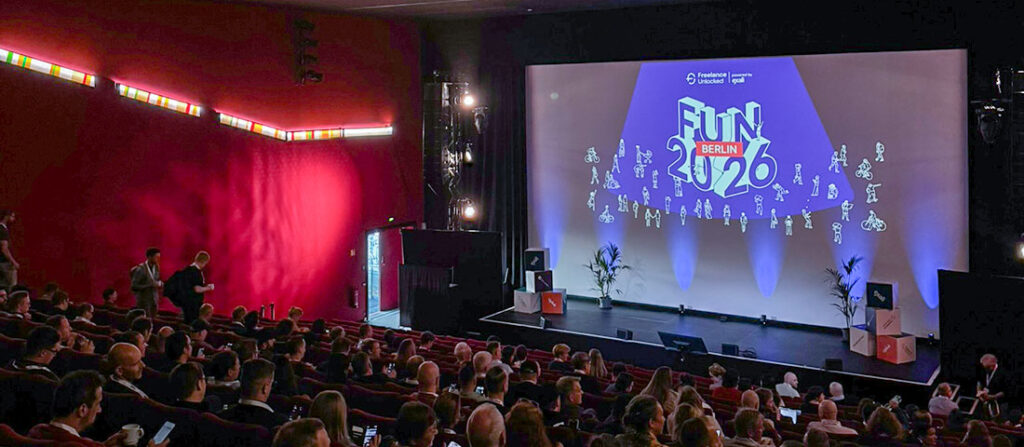
Freelance Unlocked is Europe’s most focused annual gathering for independent professionals. Now in its third year, the 2026 edition brought together 850 participants over two days at Berlin’s Colosseum, a venue that matched the event’s energy better than any conference centre could.
The scale has grown. This year: 5 stages (including, for the first time, a dedicated freelancermap stage), 65 speakers, and over 83 sessions covering everything from client acquisition and AI strategy to pricing, mental health, bogus employment law, and political representation.
The through-line across all of it: freelancers are navigating a market under real pressure, with tools and ambitions that have outgrown the regulatory framework around them. Nobody pretended otherwise — and that honesty is what made the two days genuinely useful.
The state of freelancing in Germany: Hard data, honest conclusions
The freelancermap stage opened with one of the most data-rich sessions of the conference: the live presentation of the Freelancer Study 2026 (DACH region), delivered by freelacermap’s CEO, Thomas Maas and Sherin Kharabish, Director of Strategic Marketing.
The headline finding was uncomfortable, and Thomas presented it plainly: the average hourly rate among German freelancers has fallen for the first time since the study began. At the same time, many freelancers are reporting higher workloads and less planning security than in previous years.
This is not the picture of a market thriving under supportive conditions. It is the picture of a market that is resilient despite the conditions, not because of them.
“I want a working world where you can change your model flexibly, depending on what you need — and where freelancing becomes completely normal.” – Thomas Maas, CEO freelancermap
That vision of normalisation is both aspirational and pragmatic. Germany still has a significantly lower rate of self-employment than the EU average. The freelancers who are here are, by and large, satisfied, but they are operating against structural friction that costs them time, income, and certainty.
💡What this means for you: If your rates have felt harder to hold or push upward lately, you’re not imagining it, and you’re not alone. The market data reflects a genuine squeeze. Understanding that context helps you price and position more strategically, rather than assuming the pressure is personal.
AI is your competitive edge
AI was not a single session at Freelance Unlocked 2026. It was a recurring thread woven through almost every stage, every discipline, every conversation.
The tone was neither hype nor panic. It was something more useful: clarity.
Hubert Staudt and Marcel Pesch opened the AI conversation in “AI — Gamechanger or Danger?”, mapping the real opportunities for solo professionals who move fast. Their core argument: freelancers who act now — who experiment, test, and integrate AI into their workflows — gain a structural advantage over larger, slower-moving competitors. The bottleneck isn’t access to the tools. It’s the willingness to use them before you feel fully ready.
Ralph Günther, founder of exali, made the same case from a different angle in “At the Speed of AI: Why Speed Beats Perfection.” The freelancers who win, he argued, are not the ones who wait for the perfect AI workflow — they’re the ones who start iterating immediately.
But the session that generated the most discussion was Marco Janck’s deliberately contrarian talk: “Brand Building as a Freelancer in the Age of AI.”
Janck’s thesis: AI can and should support your brand-building, but the brand itself cannot come from AI. It comes from your answer to two questions that no tool can answer for you — Who am I? and How am I different from everyone else?
The risk he named was “tool stacking”: layering AI tool upon AI tool until your output becomes indistinguishable from everyone else’s. The freelancers who build lasting client relationships do so because clients can identify their specific voice, their specific thinking. AI that erases that distinctiveness is not a competitive advantage; it is a liability dressed up as efficiency.
Zsike Peter reinforced this in her session, “The Intellectual Freelancer”: the goal is not to use AI more than your competitors, but to use it in a way that amplifies your thinking rather than replacing it.
💡What this means for you: Experiment aggressively with AI tools. But protect your voice. The clearer your positioning and the stronger your personal perspective, the more useful AI becomes as an amplifier — and the less at risk you are of producing generic output in a market that already has too much of it.
The political reality: Still lagging, still urgent
Year after year, the gap between how freelancers work and how legislation treats them remains embarrassingly wide.
The Day 1 political panel — “The Political Landscape for Freelancers and Sole Traders in Germany”, brought together Sandra Stein (Die Grünen), Wilfried Oellers (CDU/CSU), and longtime freelance advocate Cathi Bruns. The conversation was frank, occasionally tense, and ultimately honest about how slowly things move.
Cathi Bruns cut to the core of the frustration:
“Opposing self-employment is opposing your own economic base. Freelancing is a stimulus programme that costs us nothing. Just let us work.”
She went further, framing the issue not just economically but culturally: Germany has a distorted relationship with self-employment, and normalising it, in law, in public discourse, in political priority, is long overdue.
Sandra Stein’s call was for cross-party cooperation: “The parties need to finally sit down together and take this seriously.” Wilfried Oellers acknowledged that a parliamentary reform was, in principle, achievable before the end of the year. But when pressed on what specifically would change (and why the same conversations have been circling for years without concrete movement) what followed was a long pause, and then a vague answer.
For much of the room, that pause said more than any policy statement could.
The underlying political reality is that freelancers are economically significant, politically underrepresented, and still waiting for a legislative framework that reflects how they actually work.
💡What this means for you: The political environment is shifting, but slowly. Staying connected to advocacy organisations like VGSD and DBITS is not just civic participation — it directly affects the conditions under which you run your business. The Freelance Unlocked community is increasingly vocal, and that pressure matters.
False self-employment: The question nobody can stop asking
If one session could be said to have drawn the most intense, most practically urgent energy of the conference, it was the Q&A on Scheinselbstständigkeit hosted on the freelancermap stage.
Robert Gollwitzer (specialist employment lawyer) and Sherin Kharabish (Director of Marketing, freelancermap) fielded questions from a packed audience. The volume and specificity of those questions told the real story: years into this debate, freelancers and the companies that hire them are still operating in legal uncertainty.
A dedicated expert panel, featuring Jörn Freynick, Rainer Schlegel, and Silke Becker, explored the planned reform of false self-employment rules in more depth. The conclusion was familiar but no less serious for it: the “Sword of Damocles” (as one panellist put it) of potential reclassification hangs over every single freelance contract.
Bureaucracy, legal uncertainty, and lack of political recognition limit individual freelancers’ ability to take on certain clients, structure certain projects, and plan with any reasonable degree of confidence.
💡What this means for you: If you work predominantly with a single client, or if you’re unsure whether your current contracts would survive an audit, professional legal advice is not a luxury — it is an operating cost. The reform discussion is live, but timelines are unclear. Build your risk awareness now.
Pricing, positioning, and the business of being a freelancer
One of the more grounding themes of Day 2 was a simple but often avoided truth: most freelancers struggle because they don’t run their business like a business.
Joachim Groth’s session: “What’s Your Last Price?”, tackled the freelance pricing triangle: freelancer, intermediary, and client. His core argument: price is not just a number. It is a signal of positioning, self-image, and how clearly you can communicate your value. Many skilled freelancers undercharge not because the market won’t support higher rates, but because they haven’t done the internal work of knowing precisely what they’re worth and why.
That combination of calculation and confidence is learnable. But it doesn’t happen automatically, and it doesn’t come from doing more projects.
Elina Jutelyte’s session “Rock Solid Positioning: A Simple Framework for Freelance Success” challenged the common misconception that positioning is just a niche statement or tagline. She introduced the 8Ps framework, showing how successful freelancers build strong market positions by aligning Product, People, Place, Promotion, Physical Evidence, Process, Performance, and Price into a cohesive system.
Attendees learned how to diagnose weak points in their positioning, identify inconsistencies that may be limiting growth, and create strategic alignment across all areas of their business to attract the right clients and command the right rates.
Maruan Faraj pushed the ambition further in his session on the 2026 strategy for freelance designers, developers, and marketers aiming for €100,000 in monthly revenue. The path from solo freelancer to scalable business requires moving from selling time to building something that operates without you in every project.
Jessica Ortner added a cross-border dimension in “Freelancing Without Borders – Where Freelancers Thrive Across Europe,” exploring how different European markets present different opportunities and risks for independent professionals.
💡What this means for you: Know your number. Not a vague sense of what you’d like to earn, an actual calculation of what your time costs, what your expertise is worth, and what clients in your segment are genuinely willing to pay. That clarity is the foundation of every confident negotiation.
From freelancer to brand (and maybe to agency)
At what point does a freelance practice become a brand, and when does a brand become something bigger?
Bao Hanh Nguyen made the strongest case for community as a business asset, not just a marketing channel. In “From Freelancer to Scalable Brand,” she argued that sustainable growth is not about accumulating more clients or more visibility. It happens when your positioning, your offering, and the community around you align precisely enough that inbound interest becomes predictable.
Thomas Marbella took the argument to its logical conclusion in “From Freelancer to Agency”, a session that addressed the questions many established freelancers eventually ask: When do I hire? What does a healthy pipeline actually look like? Do I still need to be operationally involved in every project?
Scaling has real costs: in management overhead, in creative control, in the kind of work you end up doing day to day. Whether those costs are worth it depends entirely on what you want your working life to look like.
Andreas Steinle of the Zukunftsinstitut opened Day 2 with a different kind of growth frame: “Future Skill Curiosity.” His argument: in a market shaped by AI and accelerating change, the freelancers who thrive long-term are the most curious, the ones who keep asking good questions rather than optimising for the answers they already have.
💡What this means for you: Before you invest in scaling, get clear on what you’re scaling toward. More revenue is not a strategy. A business model that works without you trading hours for every euro is a strategy, but it requires deliberate design, not just growth.
freelancermap’s stage: The conversations that mattered most
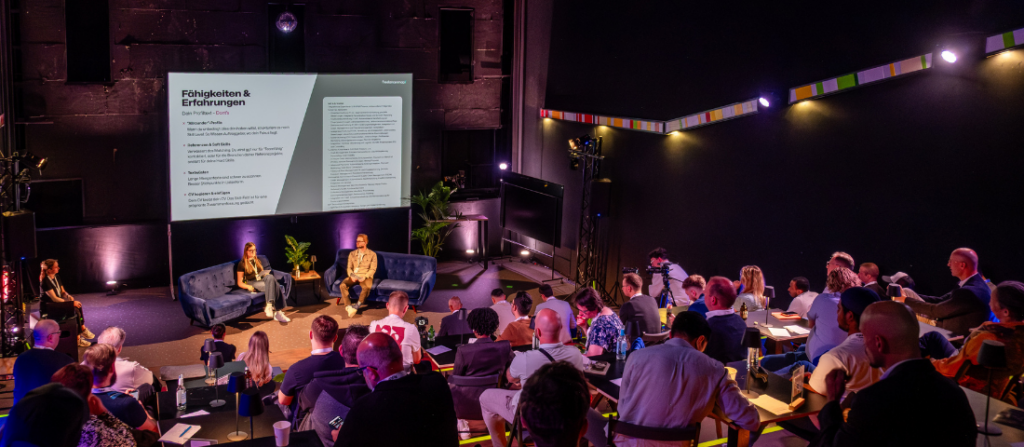
For the first time at Freelance Unlocked, freelancermap had its own dedicated stage, and it became one of the busiest spots at the Colosseum across both days.
7 sessions ran in there, covering some of the most practical topics a freelancer can walk into. E.g. how to build a profile that actually wins projects.
Beyond the stage programme, the freelancermap team ran one of the most talked-about formats of the entire conference: Speed Networking.
The concept is simple. Strangers. Five minutes. Rotate. Repeat.
In under an hour, people who had never met were exchanging rate benchmarks, referral contacts, war stories about difficult clients, and strategies that had actually worked. Freelancing can be an isolating practice — you rarely get to benchmark yourself against peers in real time. Speed Networking collapsed that distance almost immediately.
💡What this means for you: If you haven’t checked your freelancermap’s freelancer profile recently, it’s a good moment to do so. The freelancers who use the platform actively — and keep their profiles current — are consistently better positioned when new projects land.
5 takeaways for freelancers who weren’t there
1. Rates are under pressure — and the data confirms it. The Freelancer Study 2026 found average hourly rates falling for the first time. If you’re feeling squeezed, it’s a market dynamic, not a personal failure. The response is sharper positioning, not more hours.
2. AI strategy means protecting your voice, not just learning new tools. The most useful sessions on AI were the ones that asked what you stand to lose if you automate indiscriminately. Use AI to amplify your thinking. Don’t let it replace it.
3. False self-employment reform is coming — but it’s not here yet. The expert panels were clear: uncertainty remains high, reform timelines are vague, and every contract still carries exposure. Seek legal advice if you’re unsure about your current arrangements.
4. Price is positioning. If you find it hard to hold or raise your rates, the problem is probably not the market. It’s usually clarity about what you offer, who it’s for, and how to communicate that value without apologising for it.
5. Community is a professional asset. The freelancers who left Berlin with the most were the ones who treated networking not as a social obligation but as a business activity. The connections made at Freelance Unlocked tend to produce referrals, collaborations, and reality checks that no online forum can replicate.

