Freelancers and the self-employed know it all too well: dry spells and project droughts, the constant ebb and flow of workload. One moment you can barely keep up with project enquiries. The next, the market feels like a barren wasteland. But these phases are simply part of freelance life. All the more reason to develop strategies for weathering the quiet periods and making the most of them.

Key takeaways
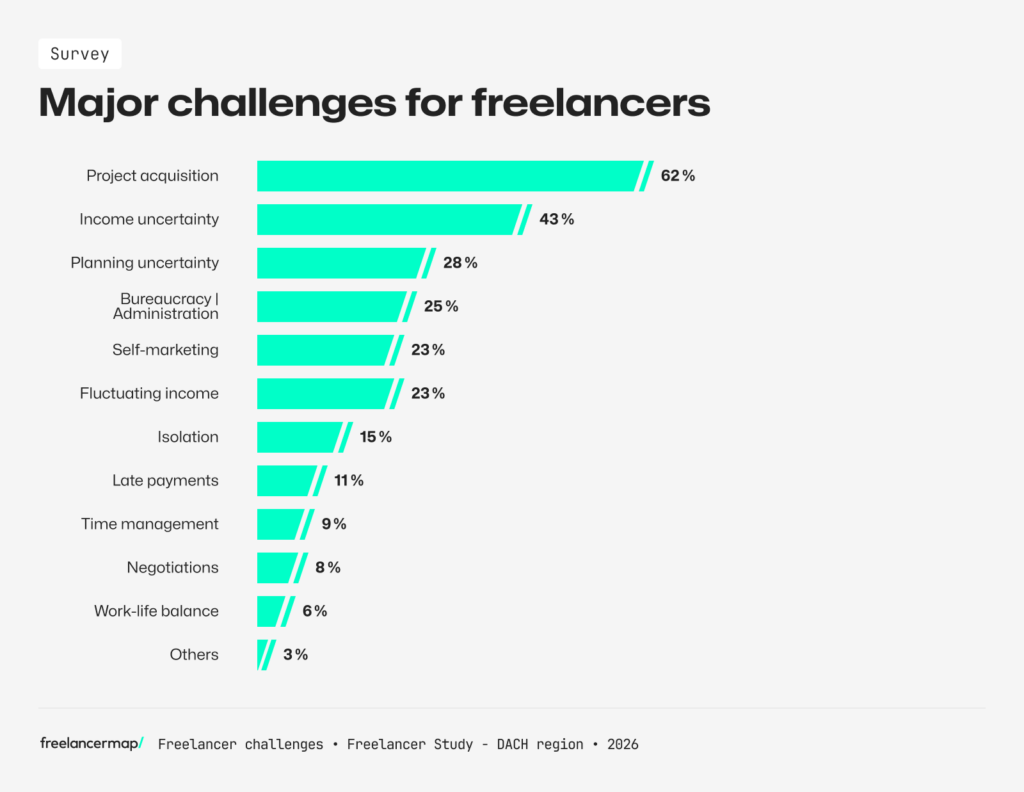
- 62% of freelancers consider finding new projects their biggest challenge.
- 43% struggle with irregular income, and 28% with the lack of financial predictability.
- Bureaucracy (25%) and self-promotion (23%) also rank among the most common pain points.
- Long-term clients, consistent marketing, and a financial buffer all help to get through lean periods more comfortably.
- Quieter phases can be used productively to upskill or expand your professional network.
Join our freelancer community today!
Create your profile in just 2 minutes and start attracting new clients.
The biggest challenges freelancers face
Life as a freelancer isn’t always easy, but it’s rarely dull. Sometimes everything clicks into place and the work comes flooding in. Other times, it feels as though every potential client has collectively decided to ignore you.
Keeping a steady stream of projects on the go is something many freelancers find genuinely difficult. According to our latest Freelancer Survey 2026, 62% of freelancers regard winning new projects as the single greatest challenge of freelance life.
The goal, of course, is a healthy work-life-balance: enough work to live comfortably, but not so much that your work-life balance takes a permanent hit. And even when a dry spell does creep in, it doesn’t have to spell disaster.
Here are our tips for coming out the other side in better shape.
1. Focus on long-term clients
Working across a wide variety of projects is exciting and keeps the day-to-day interesting. That said, it’s well worth directing a portion of your efforts towards building lasting client relationships.
Winning new clients takes considerably more time and energy than retaining existing ones. A large chunk of the time freelancers spend chasing small, one-off projects ultimately goes unpaid.
It’s therefore worth seeking out clients with whom you can establish an ongoing working relationship. This creates a more stable income and reduces the need for constant new-business development.
Make a habit of checking in with former clients from time to time to ask how their projects are progressing. If you already know their business, you’re well placed to pick up follow-on work.
2. Keep the marketing machine running
When business is booming, many freelancers slip into a kind of marketing torpor. Work is coming in, projects are landing on their own. Who has time for promotion?
But this is precisely what can cause problems further down the line. Marketing shouldn’t be something you do occasionally. It needs to be a regular part of how you work.
It can help to block out a fixed slot each week (for example an hour) dedicated solely to self-marketing. This might include posting on social media, networking, updating your freelancer profile, or reaching out to prospective clients. Many of these activities can be automated, which means they cost less time in the long run.
Be proactive about putting your services out there. Don’t just wait to be found. A well-crafted freelancer profile helps you win projects and showcase your expertise.
3. Think like your client
When work dries up, it’s worth stepping back and viewing your own offering through the eyes of a potential client. What does someone actually experience when they land on your website or freelancer profile?
Every touchpoint should be as clear and straightforward as possible. If key information is missing or something isn’t working smoothly, prospective clients will often move on without a second thought.
Regularly ask yourself:
- Is my portfolio up to date?
- Are testimonials and references clearly visible?
- Are my services described in plain, accessible language?
- Is it easy for someone to get in touch?
A fresh pair of eyes can be invaluable here. Friends or colleagues will often spot gaps or friction points far more quickly than you can yourself.
4. Make the most of the quieter times
A project drought doesn’t have to mean wasted time. It can actually be a great opportunity to invest in your own skills and development.
What often sets one freelancer apart from another is their depth of knowledge, range of experience, and areas of specialism. Quieter periods are therefore the ideal time to focus on learning.
Options include webinars, online courses, exploring new tools or technologies, or simply catching up on industry reading.
Consistently broadening your skillset improves your long-term prospects of landing new projects and strengthens your competitive position at the same time.
5. Plan ahead for dry spells
Many industries have predictable seasonal lulls. During the summer months or around bank holidays, key contacts tend to be harder to reach and new projects are slower to get off the ground.
Freelancers can plan for these periods deliberately. If every year follows a similar pattern with fewer projects at certain times, it makes sense to schedule your own holiday for those weeks.
A planned break gives you the chance to properly recharge, so you can return to work refreshed and motivated.
6. Save rather than splurge
Once a dry spell is behind you and the money is flowing again, the temptation to treat yourself is entirely understandable. There’s nothing wrong with that in principle.
But freelancers would do well to keep in mind that an irregular workload is simply part of being self-employed.
Having a financial cushion makes it far easier to handle the quieter periods without stress. Many self-employed people manage this by using multiple accounts or ring-fencing savings. The idea is to keep your income in a main account and pay yourself a set “salary” from it, with separate pots for leaner times, holidays, and so on.
This naturally builds up a financial buffer that provides a genuine sense of security, even when projects are thin on the ground.
FAQ

You might also find these posts interesting: