


2026 is shaping up to be a transformative year for freelancers and self-employed professionals. With technological breakthroughs, regulatory shifts, and evolving client expectations, the freelance landscape is changing faster than ever. Let’s dive into what’s already happened, what changes are on the horizon, and which trends will define success for independent professionals in 2026.
- Quick overview: What you need to know
- What changed in 2025?
- Trends: What will matter in 2026
- Succeeding in 2026
Join our freelancer community today!
Create your profile in just 2 minutes and start attracting new clients.
Quick overview: What you need to know
- Political reforms are stalling: Many of the initiatives launched in 2025 – like clearer employment status guidelines and reduced bureaucracy – remain stuck in discussion phases heading into 2026.
- Tax changes are catching people off guard: New revenue thresholds for small businesses sound great on paper, but the removal of buffer zones means even small miscalculations can trigger immediate tax status changes with serious financial implications.
- AI is no longer optional: In 2026, artificial intelligence and automation tools have become fundamental to how freelancers work, directly impacting productivity, project scope, and what clients expect as standard.
- The market rewards specialists: Clear specialisation, strong professional networks, and the ability to prove your impact with data are becoming non-negotiable for winning projects and commanding premium rates.
What changed in 2025?
2025 brought significant shifts for freelancers across Europe, though not always the ones that were promised. In Germany, the most notable change was the overhaul of small business tax regulations (reformierte Kleinunternehmerregelung), which raised revenue thresholds but created new complications in the process.
On the political front, coalition governments across Europe made bold promises to prioritise solo entrepreneurs and freelancers. Issues like simplifying employment status determinations and cutting red tape were supposed to be addressed. Yet here we are in 2026, and many of these structural reforms remain frustratingly incomplete.
The political promise vs. reality gap
The 2025 coalition agreement in Germany set ambitious goals: reforming how employment status is determined, eliminating bureaucratic barriers, extending maternity protections to self-employed workers, and adjusting tax frameworks to reflect modern work realities.
Fast forward to 2026, and many freelancers are asking: Where’s the actual change?
While some tax relief measures and mobility initiatives are supposedly rolling out this year, the core structural challenges remain unresolved. Social insurance access for freelancers? Still complicated. Bureaucracy reduction? Minimal progress at best.
Take Germany’s “Modernisation Agenda for State and Administration” announced in October – it promised sweeping relief but has delivered virtually nothing concrete for freelancers. Key measures like approval fiction (where applications are automatically approved if not rejected within a timeframe) either weren’t implemented or remain unclear about whether solo entrepreneurs will benefit.
The status determination procedure remains a mess. In the 2025 Freelancer Kompass survey, 60% of respondents identified this as their biggest structural headache (and nothing has changed).
The small business tax trap nobody warned you about
The January 2025 tax reform raised the small business revenue threshold to €100,000, which initially seemed like great news. But here’s the catch: unlike the old system, there’s zero tolerance for going over.
Exceed that limit by even €1, and you’re immediately subject to standard taxation. No grace period, no warning, just an instant status change that can wreck your cash flow planning.
But it gets more complicated. To maintain small business status in 2026, your 2025 revenue can’t exceed €25,000. Only then do the €100,000 limits apply for 2026. This two-tiered system is confusing even experienced freelancers.
Real-world example: Sarah is a UX designer operating as a small business owner in 2026. By October, she’s earned €98,500, comfortably under the €100,000 threshold. A client offers her a €2,000 project in November. She accepts.
Boom. She’s now at €100,500, and her small business status vanishes immediately. For November and December, she must charge VAT on all invoices and remit it to tax authorities (even though her annual planning assumed staying under the limit).
The hidden trap: If Sarah purchased services as a small business (without paying VAT) but uses them after switching to standard taxation, she needs to make input tax corrections under §15a UStG. This creates both paperwork nightmares and unexpected tax bills.
The lesson? Revenue tracking in 2026 requires military precision. One miscalculation can trigger a cascade of financial and administrative headaches.
Trends reshaping freelancing in 2026
2026 will be strongly characterised for freelancers by digital transformation, new AI tools, and increasingly specialised expertise. We’ve taken a closer look at the most important trends of tomorrow and explained what matters.
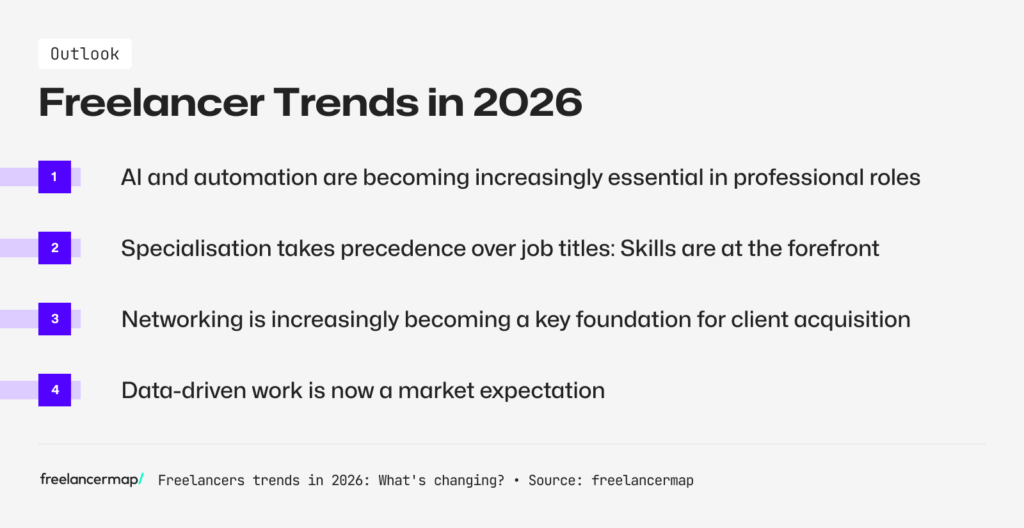
#1 AI has become infrastructure, not innovation
We’re past the point where AI is a competitive advantage. According to preliminary data from the Freelancer Kompass 2026, 84% of freelancers regularly use AI-powered tools. That’s a dramatic jump from just 41% in 2023.
Here’s how AI adoption has accelerated:
| Year | Freelancers regularly using AI software | Primary use of AI |
| 2023 | 41% | Improving efficiency & productivity |
| 2024 | 58% | Improving efficiency & productivity, brainstorming support |
| 2025 | 77% | Text creation, code, and customer communication |
| 2026 | 84% (preliminary result) | Text creation, programming, and image generation |
At this trajectory, we’re approaching near-universal AI adoption among freelancers. Those who haven’t integrated these tools are increasingly finding themselves priced out or passed over.
What AI actually does for freelancers now
The tasks being automated or augmented by AI have expanded dramatically:
Fully automated by many freelancers:
- Research and information gathering
- Content drafts (blog posts, social media, ad copy)
- Code generation and debugging
- Image creation and editing
- Basic data analysis
The next wave are AI agents and workflow automation: Tools like n8n, Make, and custom AI agent systems are enabling freelancers to build complex automated workflows. Need to scrape data, analyse it, generate a report, and email it to clients on a schedule? That’s now a 30-minute setup instead of hours of manual work weekly.
This creates a massive productivity multiplier, but also raises client expectations. Companies increasingly assume you’re using these tools and price their projects accordingly. If you’re still doing everything manually, you’re competing against people who can deliver faster and cheaper.
The preparation gap is creating winners and losers
Here’s the sobering reality: despite 84% of freelancers using AI tools, only 39% feel well-prepared for technological developments like AI and automation.
That’s a huge gap. Many people are using these tools superficially (e.g. ChatGPT for occasional writing tasks) without understanding how to integrate them strategically into their workflow. Meanwhile, early adopters who’ve mastered prompt engineering, AI-assisted project management, and automation platforms are operating at an entirely different level of productivity and profitability.
If you’re not actively investing time in understanding these tools, you’re falling behind and becoming obsolete.
#2 Specialisation beats generalisation every time
The days of the “full-stack” generalist freelancer are fading. Clients don’t want to hire “marketers” or “developers” anymore. They want specialists who can solve specific problems with demonstrable expertise.
Preliminary Freelancer Kompass 2026 data shows freelancers are responding to this shift. The most popular areas for professional development are:
- AI implementation and automation consulting
- Data analysis and business intelligence
- Agile methodologies and transformation
- Cybersecurity and compliance
- Sustainability and ESG reporting
This aligns with broader market trends. LinkedIn data shows required skills in job postings increased by over 25% between 2017 and 2025, and that acceleration is continuing.
IT skills to prioritise based on ROI timeline
These skills offer the fastest path to high-value projects:
- Python + AI Libraries (TensorFlow, PyTorch) – Universal foundation for AI work
- Cloud Security (AWS/Azure security services) – Critical shortage meeting explosive demand
- Data Engineering (Spark, Kafka, ETL/ELT) – Highest supply-demand gap
- Compliance Frameworks (ISO 27001, GDPR, DORA) – Regulatory requirements create constant demand
These skills position you ahead of market curves:
- European Cloud Platforms (Scaleway, OVH) – Data sovereignty is reshaping the market
- Open-Source AI Tools (Metabase, open LLMs) – Cost pressures driving adoption
- Low-Code AI Integration (n8n, Make + AI) – Democratization of automation
- Advanced Cybersecurity (EDR, SIEM, SOC) – AI threats requiring sophisticated defenses
Why this matters for your income: Specialists in well-defined niches consistently command higher rates and face less price competition. When you’re one of five people in your region who can implement GDPR-compliant AI systems on European cloud infrastructure, you’re not competing on price. When you’re one of five thousand “Python developers,” you are.
Looking for top talent to meet the demands of 2026?
Join freelancermap today to connect with highly skilled freelancers who are ready to bring innovative solutions to your business.
> Sign up and post your needs (2 job ads/month free)
#3 Your network is your new business development team
In 2026, networking has become the dominant source of new projects. According to the Freelancer Kompass 2026 preliminary data, 56% of freelancers now acquire work through professional and personal networks, a massive jump from just 30% in 2024.
This shift reflects several converging trends:
- Clients are more risk-averse and rely on trusted referrals
- Freelance platforms are saturated and commoditised
- Relationship-based work leads to better projects and repeat business
What works in 2026:
- Active participation in industry-specific communities (Slack channels, Discord servers, professional associations)
- Speaking at conferences, webinars, or local meetups
- Publishing thought leadership content (articles, case studies, podcasts)
- Strategic partnerships with complementary freelancers for larger projects
- Consistent communication with past clients and collaborators
Interestingly, 11% of surveyed freelancers say networking is their primary visibility and self-marketing tool, outperforming traditional personal branding tactics like social media presence or portfolio websites.
The freelancers winning in 2026 are the best at building and maintaining relationships.
#4 Data-driven work becomes a future trend
Clients in 2026 expect proof, not promises. According to Microsoft and LinkedIn’s Work Trend Index 2025, 69% of companies plan to emphasise data-based criteria when selecting external specialists.
What clients are demanding:
- Structured reporting with clear KPIs
- Transparent ROI calculations
- Performance dashboards tracking progress
- Post-project analysis quantifying business impact
Gone are the days when you could get by on experience and gut instinct. If you can’t demonstrate your impact with numbers, you’re losing projects to freelancers who can.
Data literacy: The skill that separates pros from amateurs
Data literacy (the ability to read, work with, and communicate using data) has become essential across virtually every freelance discipline. It’s not just for analysts and developers anymore.
Practical applications:
- Copywriters showing how their content increased conversion rates by X%
- Designers demonstrating how interface changes reduced bounce rates
- Consultants tracking efficiency improvements and cost savings
- Developers documenting performance optimisations with before/after metrics
The freelancers commanding premium freelance rates in 2026 aren’t just doing good work; they’re proving it with clean, compelling data that makes the business case undeniable.
Ready to stay ahead of the curve in 2026?
Stay connected with opportunities that align with the trends shaping the future of freelancing.
> Sign up now
What this means for your freelance business in 2026
The freelance market is experiencing a fundamental restructuring. To succeed in 2026 and beyond, focus on these five areas:
1. Master AI and automation tools: Understand how to build workflows, automate repetitive tasks, and use AI as a genuine productivity multiplier. This isn’t about using ChatGPT occasionally; it’s about integrating these tools into every aspect of your business.
2. Specialise ruthlessly: Pick a niche and become known for it. “I do marketing” isn’t a positioning. “I help SaaS companies reduce churn through data-driven email campaigns” is. The more specific your expertise, the less you compete on price.
3. Build measurement into everything: Start tracking and documenting your impact with data from day one of every project. Create dashboards, maintain metrics, and build case studies that prove your value. This is the “extra” work that wins you the next client.
4. Invest in relationships, not just visibility: Stop obsessing over your follower count or website traffic. Start having real conversations with people in your industry. Join communities, offer help without expecting immediate returns, and stay in touch with people consistently. Your network will generate more revenue than your LinkedIn profile ever will.
5. Stay adaptable and informed: Regulatory changes are ongoing, market dynamics shift quickly, and new tools emerge constantly. Set aside time weekly to stay current on developments in your field.
2026 isn’t a gentle evolution of freelancing, it’s a restructuring. The gap between freelancers who adapt to these trends and those who don’t is widening rapidly.
The good news? All of these trends are learnable. You don’t need to be a tech genius to use AI tools effectively. You don’t need an MBA to track basic project metrics. You don’t need to be an extrovert to build a strong professional network.
What you need is intentionality. The freelancers succeeding in 2026 are strategic. They’re investing time in skills that multiply their impact, positioning themselves clearly in valuable niches, and building systems that prove their worth to clients.
Start with one area. Pick the trend that’s most relevant to your work and commit to mastering it over the next 90 days. That single-focused effort will do more for your freelance business than scattered attempts to do everything at once.
The freelance market of 2026 rewards specialists, not generalists. It rewards people who can prove their impact, not just promise it. And it rewards those who build genuine relationships, not just broadcast their availability.
Which side of that divide will you be on?
These articles are also worth reading:


Bookmarked! I love your web site!
Thank you for this info. I’m currently looking for new work
Hi, if you are a freelancer working in the IT sector, you can browse the latest job opportunities published on our platform and apply for free: https://www.freelancermap.com/it-projects.html
This is very interesting for us freelancers
This piece of content is just fantastic.
I found a lot of things which is very insightful for a freelancer.
Thanks for posting, Keep us posted with more informative content.
[…] Freelancermap IT Trends 2026—freelancermap.com […]
[…] Around 84% of freelancers use AI tools regularly in 2026. Differentiation comes from speed, reliability, and commercial results. High-performing AI image freelancers focus on custom mockups, marketing visuals, and brand-specific content that blend human direction with AI speed. […]