A resident engineer is a qualified engineer, usually a civil engineer, stationed full-time on a construction site to represent the client or consulting engineer. They check that the contractor’s work matches the drawings, specifications and contract, inspect materials and workmanship, track progress and costs, review change requests and keep the official site records.
Role of a Resident Engineer
Resident engineers, also sometimes known as civil engineers, are in charge of overseeing construction processes and relevant staff for various projects. This can include buildings, roads, bridges, etc.
Engineers working under this title work with other professionals, like architects and city planners, to optimise cities and provide adequate infrastructure.
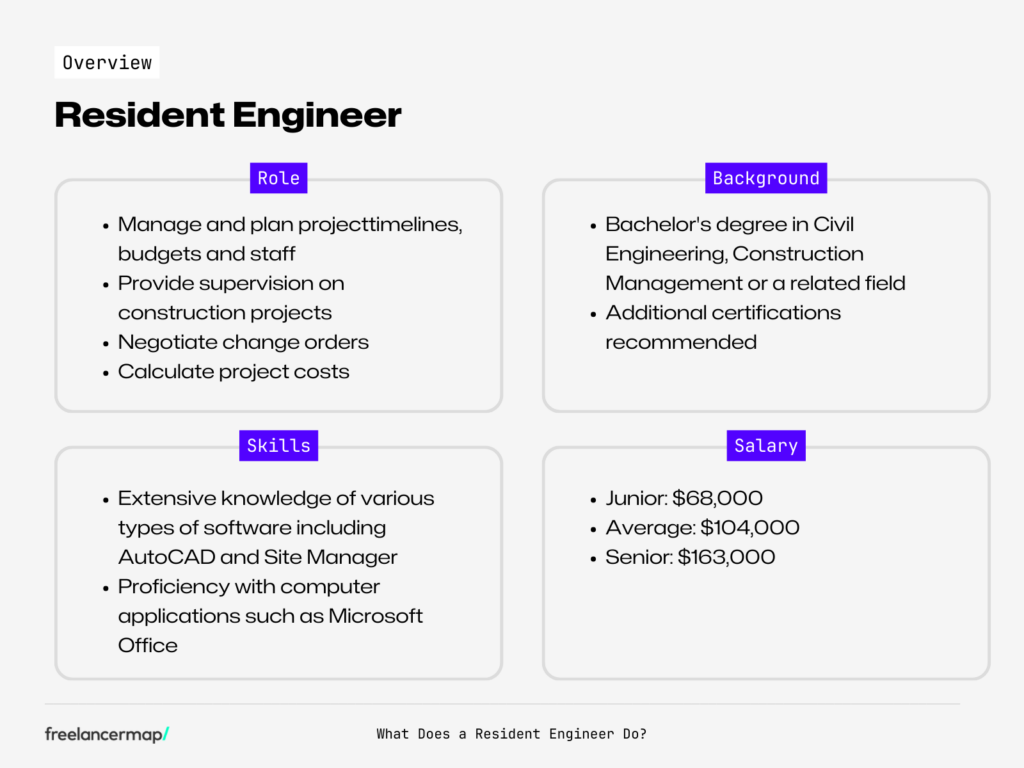
The primary job duties in this role consist of the following:
- Assisting with project design
- Reviewing regulations
- Developing efficient plans
Resident Engineer Duties and Responsibilities
A resident engineer manages and plans project timelines, budgets and staffing and provides supervision on construction projects while also providing quality assurance. They make sure that any completed work is in compliance with proper plans and specifications and ensure optimal working of all construction personnel.
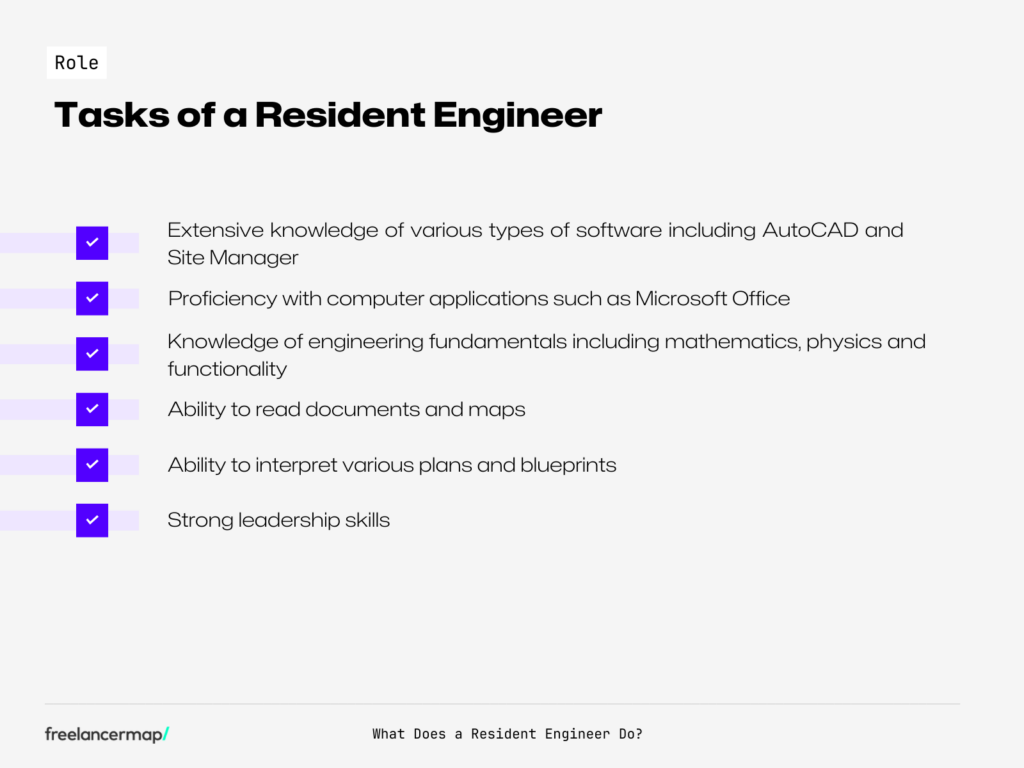
Resident engineers coordinate directly with the general contractor and negotiate change orders, calculate project costs and create budgets for construction, and study environmental effects of projects and installations. They also assess a project’s progress and inform the Project Manager in case of delay.
These engineers also oversee field site activities and provide technical advice on construction and design project proposals and record incidents or errors.
What are the responsibilities of a resident engineer?
- Supervising and inspecting the contractor’s work
- Checking quality of materials and workmanship
- Ensuring compliance with drawings, specifications and contract
- Tracking progress and reporting delays
- Reviewing variations and change orders
- Monitoring costs and certifying payments
- Health, safety and environmental compliance
- Keeping site records and daily reports
Are you looking for someone right now?
Find freelance resident engineers
Skills of a Resident Engineer
A resident engineer has extensive knowledge of various types of software including AutoCAD, Civil 3D and BIM tools such as Navisworks. Also tools like Primavera P6 or MS Project for scheduling. They are also proficient when it comes to other computer applications such as Microsoft Office.
Knowledge of engineering fundamentals including mathematics, physics and functionality is also important to have as a resident engineer. This helps professionals in this field approach problems and develop designs that can help solve them.
Resident engineers are also able to read documents and maps as well as interpret various plans and blueprints.
In terms of soft skills, resident engineers have strong leadership and communication skills and are able to think critically. They also possess excellent organisation skills.
What are the skills of a resident engineer?
- Extensive knowledge of various types of software including AutoCAD
- Contract knowledge, especially FIDIC and NEC
- Proficiency with computer applications such as Microsoft Office
- Knowledge of engineering fundamentals including mathematics, physics and functionality
- Ability to read documents and maps
- Ability to interpret various plans and blueprints
- Strong leadership skills
- Good communication skills
- Ability to think critically
- Excellent organisation skills
- Ability to work independently with minimal supervision
- Ability to work on multiple projects/deadlines
Join our IT freelancer community today.
Create your freelance profile in just 2 minutes.
Education and Background
Most resident engineers hold a bachelor’s degree in civil engineering, construction management or a related field. Before taking on the role, they typically gain several years of site experience, often as a site engineer, because the job depends on judging work quality on site, not just on paper.
Certifications and licences matter. They show clients that you can sign off work and handle contracts independently:
- Professional engineering licence or chartered status. In the US, this is the PE (Professional Engineer) licence. In the UK, it’s chartered status through the Institution of Civil Engineers (ICE). Many public infrastructure projects require the resident engineer to be licensed or chartered.
- Construction contract training (FIDIC or NEC). Resident engineers administer contracts every day: reviewing variations, assessing claims and certifying payments. FIDIC contracts are widely used in international and Middle East projects. NEC contracts are standard in UK public infrastructure.
- PMP (Project Management Professional). This is useful for resident engineers who manage schedules, budgets and reporting on larger projects, or who want to move into project management later.
Salary of a Resident Engineer
Resident engineers earn an average of $104,000 per year. Professionals who are just starting out can expect a salary of around $68,000 per year whereas those with years of experience and skills can expect a salary of around $163,000 per year.
In Germany, resident engineers can earn between €58,000-€101,000 per year whereas in the UK, they can earn between £43,000-£77,000 per year.
How much do resident engineers make?
| US | $68,000 – $104,000 |
| Germany | €58,000-€101,000 |
| UK | £43,000-£77,000 |
Freelance vs. employed resident engineers
Resident engineering is project-based by nature. A client needs supervision on site for the duration of construction, and that need ends when the project is handed over. That’s why many resident engineers work as freelancers or contractors on fixed-term assignments.
When should you hire a freelance resident engineer?
- No in-house supervision. The client, often a developer, public authority or industrial company, has no engineering team of its own to supervise the contractor.
- Extra capacity. A consulting firm has won more projects than its permanent staff can cover.
- Specialist experience. The project needs a particular type of experience, such as roads, bridges, water infrastructure or industrial plants.
- Urgent cover. A resident engineer has left mid-project and the site can’t run without supervision.
How much do freelance resident engineers make?
As of 15 October 2026, freelance resident engineers on freelancermap charge an average of €80/hour. Most freelance resident engineers charge between €60/hour and €100/hour, depending on experience, skills, project requirements and other factors.
Based on an 8-hour working day, the average freelance resident engineers rate is approximately €640/day.
| Freelance resident engineers rates | Rate |
|---|---|
| Average hourly rate | €80/hour |
| Typical hourly rate range | €60–€100/hour |
| Average daily rate (8 hours) | €640/day |
Rates are based on current freelancermap data and may vary depending on experience, specialisation, project scope and other factors. Data last updated: 15 October 2026.
Other interesting job profiles
- What Does A Mechatronic Engineer Do?
- What Does A 3D Printing Engineer Do?
- What Does An Automotive Engineer Do?
- What does an IoT Engineer do?
- What does a CNC Programmer do?
» More job profiles in Engineering
Looking to hire a skilled freelancer? Create your account in just 2 minutes and start connecting with top talent worldwide!
Sign up for free