


Freelance insurance is not required everywhere. However, health insurance is mandatory for self-employed people in most EU countries, and around 60-70% of large European companies ask for Professional Indemnity insurance to start a freelance contract.
Whether you’re a freelancer in the creative sector, IT, or consulting, understanding the freelance insurance landscape is critical to decide if you personally need cover. This guide breaks down the core freelance insurance types, what they cost in 2026, and what you should buy first.
- TL;DR: What insurance do freelancers need?
- Do freelancers need insurance?
- 7 types of insurance for freelancers
- Common claims among freelancers
- Emerging risks
- Why do clients ask you to have insurance to work with them?
- What insurance do I need? Recommendations
- FAQ on Freelance Insurance
TL;DR: What insurance do freelancers need?
- Professional Indemnity (PI) Insurance: the one most clients ask for. It covers claims that your work caused a client financial loss. Typical cost: €180–€750/year in the EU. It’s required by 60-70% of large European corporations (Exali’s data).
- Public/General Liability Insurance: covers physical injury or property damage you cause. Needed mainly if you meet clients in person or work on-site.
- Home & Contents/Equipment Insurance: covers your laptop, camera gear, or office equipment against theft, damage, or breakdown.
- Health Insurance: mandatory for independent talent in most EU countries.
- Income (Disability) Insurance: replaces 60–70% of your income if illness or injury stops you working.
- Life Insurance: protects dependents; about 25% of freelancers surveyed in freelancermap’s Freelancer Study include it in retirement planning.
- Cyber Insurance: covers data breaches, ransomware, and business interruption; increasingly requested by clients who share sensitive data with freelancers.
- Insurance premiums are generally tax-deductible business expenses (confirm with a tax professional).
- Match coverage levels to your project values and client requirements; €250,000–€1,000,000 coverage is enough for most freelance work.
- Compare quotes from at least 2–3 providers. Pricing for identical coverage can vary between insurers.
- The cost of being uninsured when something goes wrong is almost always higher than the cost of the policy.
Do freelancers need insurance?
Income security, liability coverage, health protection and legal compliance are typically provided in a full-time job. On the other side, freelancers are responsible for their income, their health coverage, and their business’s liabilities.
Insurance is how freelancers replace each of those:
- Health protection: To ensure you’re covered in case of illness or injury.
- Liability coverage: To protect yourself from legal actions, especially if a client claims damages or errors in your work.
- Income security: To safeguard against periods of low or interrupted earnings.
- Legal compliance: Some countries in the EU mandate specific types of insurance.
In short, insurance is a vital tool for mitigating risks and ensuring that your freelance career remains financially stable and legally compliant.
Here’s an example: You take on a project worth tens of thousands of euros. Equipment fails near the deadline, the project fails, and the unhappy client sues you for the full contract value.
Without insurance, you personally cover legal fees and any settlement (even though it was not your fault). With the right insurance policy, the insurer handles everything.
Freelance insurance is something that you need to consider depending on where your freelance business currently stands. A smaller-scale freelancer doing low-value projects may not be able to justify the cost of insurance.
But if you’re a freelancer who works on big projects or larger clients, insurance is no longer a “nice to have” but a practical requirement. Increasingly, clients ask for it before singing a freelancer contract.
Join our freelancer community today!
Create your profile in just 2 minutes and start attracting new clients.
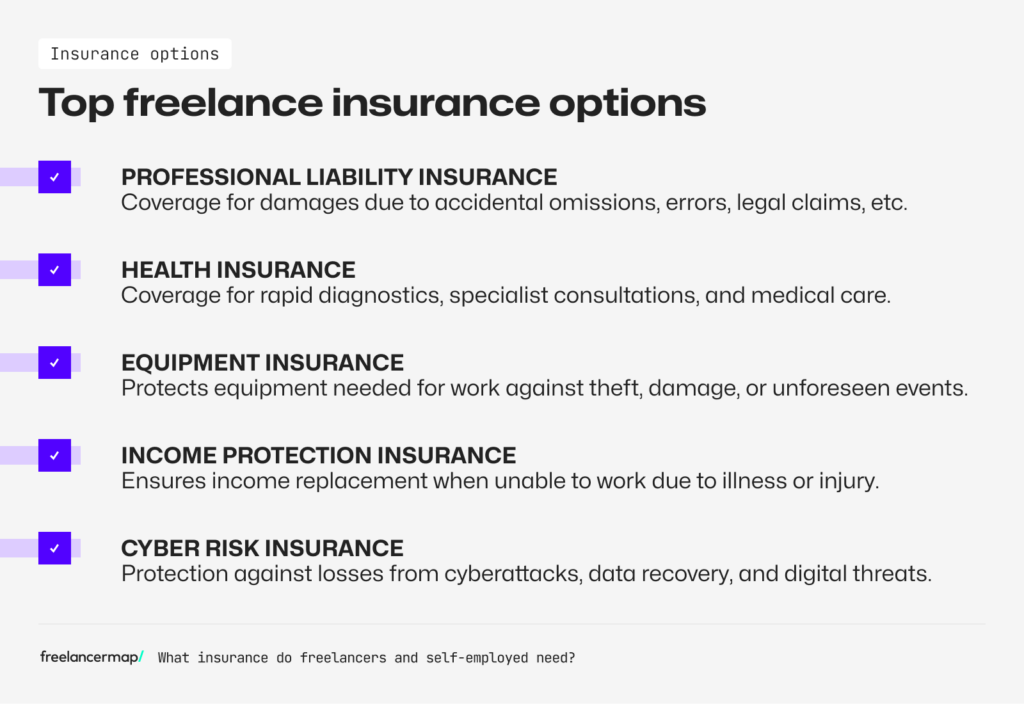
What insurance do freelancers and self-employed need?
1. Professional Indemnity Insurance (Professional Liability / E&O)
Professional Liability Insurance, also called Professional Indemnity Insurance or Errors and Omissions (E&O) Insurance, is one of the most common types of insurance used by freelance professionals.
It protects you against clients suing on the basis of product negligence due to an accidental omission, an error or even slander. Many larger clients won’t sign a contract without proof of it.
What does Professional Liability Insurance cover?
- Intellectual property disputes
- Damage to persons, materials, and property
- Possible costs resulting from legal proceedings
- Data protection
- Legal defense costs
- Economic loss to the client due to the damage (consequential damages)
How much does the liability insurance policy cost?
Annual premiums vary significantly depending on the country and the coverage. Taking the case of a developer, and considering insuring €250,000, the approximate premium could range between €180 and €250. For those with higher revenues or a larger number of clients who want to insure, for example, €600,000, the premium would be closer to €500 to €750.
Coverage levels in Europe
- Minimum coverage: €250,000 (suitable for smaller projects)
- Standard coverage: €1,000,000 (required by most corporate clients)
- Premium coverage: €2,000,000+ (for high-risk or high-value work)
Real-life example: María, a freelance web developer, took out a liability insurance policy with coverage of €250,000 for €200 annually. At one point, a programming error in an online store caused the client to suffer losses because the store wasn’t available during the launch of a campaign. Her liability insurance covered both the €35,000 in compensation and the €8,500 in legal expenses.
exali offers freelancermap members discounted European Professional Indemnity cover, with policies available from around €126.20/year net depending on location.

2. Public Liability Insurance
Public Liability Insurance (called General Liability in the US) covers you if a client or third party suffers physical injury or property damage because of your business activity.
But do freelancers really need liability insurance? You are most likely to need one if:
- You host workshops or trainings in person
- You meet clients in person (e.g., at your office or theirs)
- You attend events, trade shows, or networking sessions
- You rent office or coworking space
In many countries and industries, Public Liability Insurance is not legally required for freelancers. However, some clients may insist on it, especially for in-person work or in areas like:
- Event management
- Photography or videography
- Consulting or coaching (with in-person sessions)
- IT support or tech installation
However, if you work from your home and don’t usually invite clients over, the risk of injuring someone at your work premises is probably not high enough to justify the expense.
3. Home and Contents insurance
If you work from a home office, check whether your exisitng home insurance covers your office and business equipment. Sometimes they do, but mayny standard policies exclude professional gear.
Freelance Content and Equipment Insurance protects your work tools against:
- Theft or robbery
- Accidental damage
- Electrical or electronic breakdowns
- Data loss
What are the costs of this insurance?
The premium depends on the insured equipment. A basic coverage for up to €3,000 in equipment could cost between €120-€200 annually. For example, to cover €10,000 worth of equipment, including servers, the cost could range from €350 to €500 per year.
Real-life example: Manuel, a full-stack developer, took out insurance for his equipment valued at €4,500 (laptop, professional monitor, iPad, and smartphone) for €245 annually. When his backpack with the laptop and tablet was stolen during a business trip, the insurer reimbursed him €2,800 to replace the equipment in less than 10 days, allowing him to continue his projects with minimal interruption.
4. Health Insurance
In Europe, public health insurance is a key component of many countries’ healthcare systems, and freelancers often have to contribute to this system. However, the rules regarding whether freelancers must be on the public system vary from country to country:
#1 Germany
Germany has one of the most complex freelance health insurance systems. Freelancers in Germany can choose voluntary public health insurance (GKV, income-based) or private health insurance (PKV, more flexible).
Comparison: Public vs Private Health Insurance in Germany
| Public (GKV) | Private (PKV) | |
| Entry level | €278/month (statutory minimum) | 30-year-old: €250–500/month for a solid tariff |
| Mid-range | Rises with income up to the contribution ceiling | 40-year-old: €350–600/month |
| Maximum | €1,261/month (statutory contribution ceiling, applies regardless of age) | 50-year-old: €500–800/month |
#2 France
Freelancers, known as auto-entrepreneurs, must pay into the Sécurité Sociale (public health system). This covers medical expenses, but many freelancers opt for additional private insurance for more comprehensive care.
#3 Spain
Freelancers in Spain must also contribute to the Social Security system, which includes health coverage. However, many freelancers choose to add private insurance for quicker access to specialists or additional services.
#4 Netherlands
Freelancers are legally required to take out basic health insurance Zorgverzekeringswet (Health Insurance Law), which covers essential medical care like hospital visits, surgery, and medication. The average cost of basic insurance in the Netherlands is around €100 to €130 per month. Many freelancers opt for additional coverage for services like dental care, which can cost an additional €20 to €50 per month.
#5 Portugal
Freelancers in Portugal must contribute to the public Social Security system (Segurança Social), with monthly contributions around €200 to €300 depending on income. For private insurance, freelancers typically pay between €30 and €120 per month for supplemental coverage, depending on their needs.
Do freelancers opt for additional private Health Insurance?
While many freelancers are covered by public health insurance, many opt to supplement this coverage with private health insurance for a range of reasons:
- Faster access to care: Public systems often involve long waiting times for appointments, so private insurance can help freelancers access care more quickly. This is especially true in countries like Germany, France, Spain, and Portugal, where public systems are effective but may require longer waiting periods for non-urgent treatments.
- Better coverage: Private insurance can fill gaps in public healthcare systems, including dental, vision, mental health, and alternative therapies. In France, for example, the public system reimburses only a portion of dental or optical expenses, so private insurance is often used to cover these additional costs.
- Personalised care: Private health insurance policies often offer more flexibility in choosing healthcare providers, which is crucial for freelancers who need to ensure they receive top-quality care without long delays.
Real example: Elena, a 32-year-old freelance developer, takes out private health insurance for €60 per month, which includes 12 annual physiotherapy sessions. After spending long hours in front of the computer, her back is often sore, and she particularly appreciates the physiotherapy coverage included in her policy.
Health insurance for freelancers: Remote Health by SafetyWing
If you’re looking for health insurance that works regardless of where you live, work or travel, you should check out SafetyWing’s Remote Health Insurance. We have partnered up with them to give our members access to exclusive plans especially designed for freelancers. With Remote Health, the freelancermap community can:
- Access the best healthcare in 185+ countries
- Coverage in your home country and during long-and short-term travel
- See any doctor at and clinic or hospital, private or public
- 24/7 access to support team run by real humans
- Mental health and wellness benefits included
Log in to your freelancermap account to see the different plans available.
Just looking for short-term travel insurance?
Explore SafetyWing’s travel medical insurance: Nomad Insurance
Get coverage for accidents or emergencies while outside of your home country. Nomad Insurance includes coverage for lost checked luggage, travel delays, or trip interruptions. You can purchase Nomad Insurance while already abroad and it covers home trips and visits, too!
5. Income insurance
Income Insurance is designed to replace part of your income if you become temporarily or permanently unable to work due to health reasons — whether it’s a serious illness, accident, burnout, or long-term medical condition.
It typically provides monthly payouts based on your previous income level (usually around 60–70%), helping you cover living expenses, medical costs, or business obligations while you recover.
How much does income insurance cost?
It varies depending on age and health, profession and risk levels, or income covered. A healthy freelancer in their 30s might pay between €30–€100/month, depending on coverage level.
Tip: Policies often have a “waiting period” (e.g. 30–90 days) before payouts begin, so consider building a small emergency fund to cover that gap.
6. Life insurance
As a freelancer, your livelihood is directly tied to your ability to work. However, what happens if you’re suddenly unable to work due to illness, injury, or death? This is where life insurance becomes an essential part of your financial planning.
Keep in mind that the types of life insurance available to you depend entirely on the country you live in.
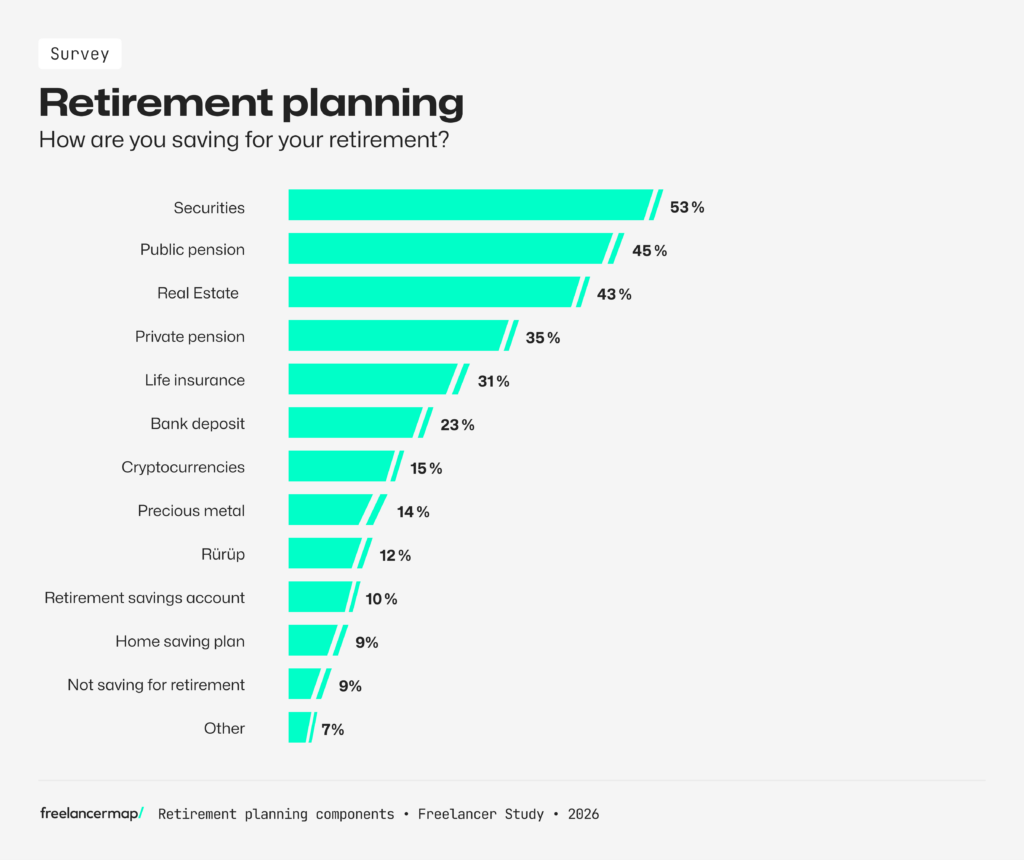
According to our latest Freelancer study, 31% of freelancers have life insurance as a component of their retirement planning:
7. Cyber insurance
Cyber insurance, also called cyber liability insurance, is an insurance policy that can help protect your business against any losses that might occur from cyber attacks and cyber crimes.
Because cyber attacks are becoming more common and sophisticated these days, you should consider getting cyber insurance for your business. All it takes is one hack to jeopardise your company data or even worse, that of your customers.
Cyber insurance typically covers:
- Data breaches involving sensitive information
- Business interruption losses
- Cybersecurity and privacy liability
- Crisis management
- Media liability
The most commonly used ransomware strategies by cybercriminals that affect SMEs and freelancers are:
- Phishing: Emails impersonating trusted identities to deceive victims.
- Exploit of vulnerabilities: Searching for flaws in programs to infiltrate systems and access information.
- Extortion: In addition to accessing data, threats to publish it if no financial compensation is made.
Real example: Ana, a freelance developer specialised in e-commerce, took out cyber insurance for €380 annually. During a project, her team suffered a ransomware attack that encrypted all of their files. The insurance covered the services of a cybersecurity specialist (€2,200), data recovery (€1,800), and compensation for downtime (€3,600), preventing a loss that would have seriously jeopardized her business.
Most common claims by freelancers
Over 90% of claims reported to exali involve pure financial losses, primarily in the following categories:
- Legal infringements (approx. 40%)
- Non-performance or poor performance, resulting in compensation claims (approx. 27%)
- Cyber incidents (e.g., hacker attacks)
- First-party losses, such as premature project termination
Freelancers can reduce this risk with contract clauses that clearly define responsibilities:
- A clause stating that the client must sign off on each stage of the work
- A clause acknowledging that bugs are inevitable, and outlining your responsibilities for bug fixing
- A clear definition of project scope and delivery dates, to avoid disputes related to time management or unmet expectations
Emerging risks freelancers should know about in 2026
Our insurance partner, exali, has identified several emerging risk areas that are becoming increasingly relevant for freelancers across industries:
1. Generative AI and Copyright infringement
With AI tools now part of everyday workflows (from content creation to coding), freelancers face a new type of liability: copyright issues. If AI-generated work unknowingly violates intellectual property laws, you could be held responsible. Make sure your tools and outputs are reviewed, and understand your liability before hitting “send.”
2. Cyberattacks and data breaches
Cybersecurity is no longer just a concern for big corporations. Freelancers working with sensitive client data, especially across platforms and borders, are also at risk. The good news? With exali, third-party cyber damages are automatically covered in their Professional Indemnity policies — a crucial layer of protection in today’s remote work environment.
3. ESG Misadvice (Environmental, Social, Governance)
As more clients align with ESG goals, freelancers (particularly consultants), may be asked to provide strategic input or reporting. But if advice leads to reputational damage or non-compliance, you could be held liable. ESG is not just a buzzword; it’s a growing risk category.
4. Platform liability
Working through third-party platforms can open up freelance opportunities (and legal grey areas). Disputes over deliverables, unclear contract terms, or platform-specific obligations may leave freelancers exposed. Be sure you understand who’s responsible for what, especially when working internationally. Platforms like freelancermap are designed to keep freelancers in control of their own scope, deadlines, and payment terms directly with clients.
5. Project delays and missed deadlines
In today’s fast-paced project environments, a delay (even for reasons outside your control) can have financial and legal consequences. Clients expect results, and if they suffer losses due to a late delivery, you could be asked to compensate.
Why do clients require freelance insurance?
Because working with an insured professional is way safer for them. It transfers the client’s financial risk to your insurer instead of leaving it as an uninsured dispute.
Hiring a freelancer can be risky for companies, as the responsibility for the job lies heavily on the freelancer and any mistake or misunderstanding can result in the company suffering financial losses.
According to exali’s experience, approximately 60-70% of large companies in Europe (with more than 250 employees) require proof of Professional Indemnity Insurance before working with freelancers. Minimum required coverage typically starts at €250,000, often rising to €1 million for larger projects.
When discussing the insurance clause with your client, ensure they are aware of the extra fees associated with a higher level of coverage. Some default templates specify €10,000,000 coverage, so it’s reasonable to propose a lower level (something around €250,000 – €1,000,000) and explain why that’s enough for the project size. If necessary, you can explore the option of raising the coverage for certain projects or situations.
Remember, the less insurance coverage you take out, the less the cost for you.
Annual premiums (for sole traders with up to €250k in revenue) vary significantly depending on the country. In German-speaking regions, coverage of €1 million for financial losses is available for a few hundred euros per year, whereas in other countries the annual premium may exceed €1,000.
Client contract insurance clauses
An insurance clause in a freelance contract typically outlines the type and amount of coverage the client expects you to have – usually Professional Indemnity Insurance (PI) or Cyber Liability Insurance.
These clauses are designed to:
- Protect the client from financial loss if your work causes damage
- Ensure you can cover legal costs or compensation in case of disputes
- Minimise project risk, especially for large or regulated clients
Common insurance requirements in contracts:
- Proof of coverage: Many contracts require you to provide a valid insurance certificate before work begins.
- Minimum coverage amount: Often set between €250,000 and €1 million, depending on project size and industry.
- Ongoing coverage: Some clients require your policy to remain active even after the project ends (to cover late claims).
- Territorial scope: The policy must cover work done across the client’s region — especially important for international clients.
Insurance clause example:
“The Contractor shall maintain Professional Indemnity Insurance of not less than €1,000,000 and Public Liability Insurance of not less than €2,000,000 during the term of this agreement.”
How much should you budget for insurance?
A useful way to frame the cost of insurance is what that premium represents relative to your billing.
Using freelancermap’s own platform rate data of freelancers in Germany and assuming an 8-hour billable day: the average freelance hourly rate in Germany is €87/h, implying a day rate of €696. Against the discounted freelancermap–exali Professional Indemnity rate of €126.20/year, that’s just 18.1% of a single day’s billing.
In other words, for a German IT freelancer billing platform average rates, a full year of coverage costs less than a fifth of a single day’s billing. It’s a marginal cost next ot hte risk it removes.
So, what insurance do I need to cover my freelance business?
| If you.. | Consider |
|---|---|
| Work with corporate clients | Professional Indemnity |
| Meet clients in person, host events, work on-site | Public Liability |
| Handle sensitive data, deliver software | Cyber Insurance |
| Own expensive equipment | Equipment Insurance |
| Depend entirely on your own income | Income/Disability Insurance |
| Have dependents | Life Insurance |
| Work internationally, move between countries | Check territorial scope, consider cross-border health coverage |
FAQ: Freelancer insurance questions
Not everywhere. But Health Insurance is mandatory for freelancers in the EU, and 60-70% of large European corporations require Professional Indemnity Insurance before signing a contract.
There is no single “best” policy. It depends on your work, but IT professionals should often prioritise Professional Indemnity first, and then add Cyber or Equipment cover based on how they work.
In the EU, typically €180–€750/year depending on coverage level and field of work. freelancermap members have access to a policy with exali starting at €126.20/year.
Professional Indemnity Insurance is the most common one with a minimum coverage of €250,000–€1 million.
€250,000 is a minimum for smaller projects. The reality is that most corporations expect at least €1,000,000.
Usually, business insurance premiums can be a deductible business expense. But confirm this in your country.

You might also like:
- Should Freelancers Sign Non-Compete Clauses?
- Intellectual Property Rights for Freelancers
- NDA for Freelancers: Non-Disclosure Agreements Explained
*Please note that this blog post should not be considered as a substitute for legal or financial advice. Each financial situation is different. The advice provided above is intended to be general and each freelancer should consider their particular financial situation before making any decisions. freelancermap partners with exali and SafetyWing and may receive a commission if you sign up through the links in this article. This doesn’t affect our recommendations.

