Freelancers face a lot of challenges in their day-to-day lives. Of course, freelancing comes with a lot of benefits too, and to succeed, you need to understand the challenges and problems faced by freelancers at an in-depth level.
freelancermap has been helping freelancers connect with companies since 2005, and we have a community of over 200,000 members. Thanks to them, we can really spot the biggest problems they face.
Every year we run our freelancer survey looking for insights and facts from the community. One of the questions in the study is: What are the biggest freelance challenges?
Join our freelancer community today!
Create your profile in just 2 minutes and start attracting new clients.
The results show a comprehensive picture of what freelance challenges and problems a freelancer faces – such as finding clients and projects, making sure you get paid on time but also enjoying the work you do, etc.
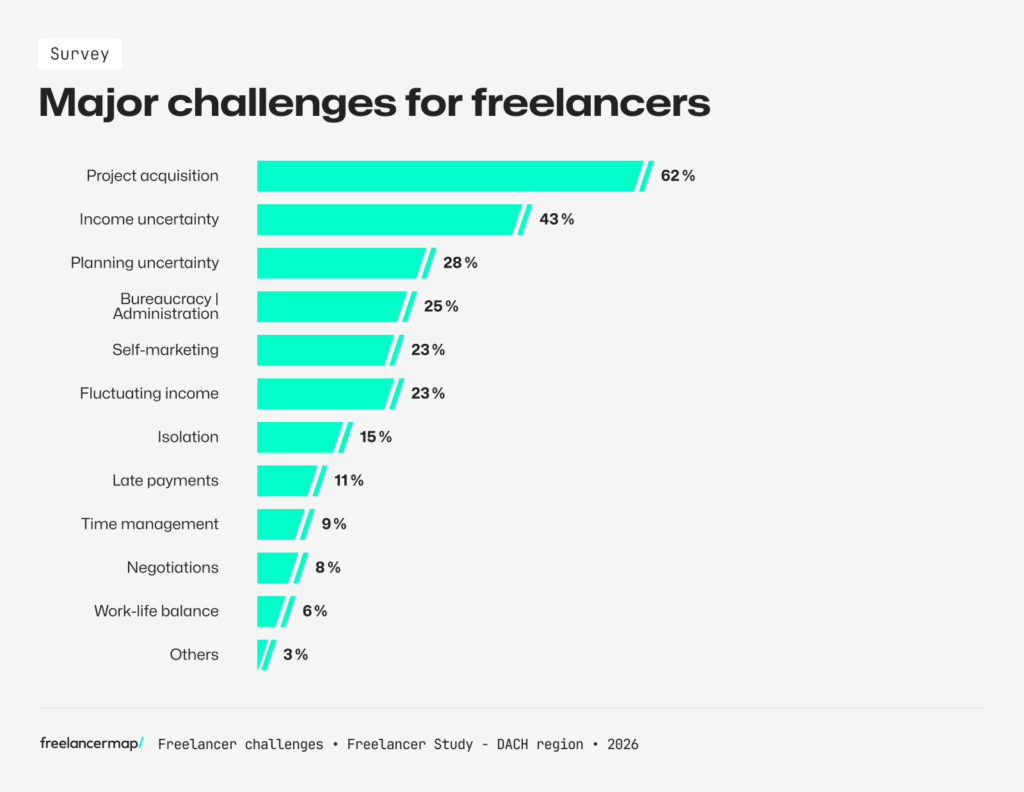
The results from the 2026 freelancer report showed that the 3 major freelance challenges were:
- Project acquisition – 62%
- Income uncertainty – 43%
- Uncertainty in planning– 28%
Also in previous studies, these freelance challenges were among the most mentioned problems faced by freelancers. Take a look a the results from 2018 and 2019:
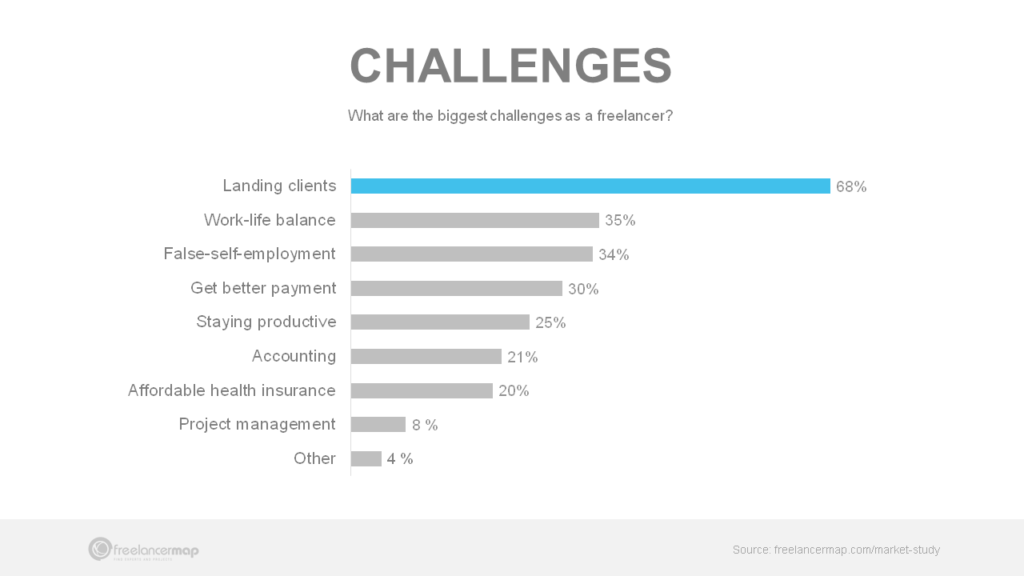

These were the top 3 freelance challenges, but there are more problems faced by freelancers. So let’s take a look at the most common ones and we’ll share some tips on how you can avoid them.
1. Landing clients
Project acquisition was, by far, the most commonly-faced challenge in our community. About half of the freelancers chose that option as the biggest issue in their career (62% in 2026).
This is not a huge surprise; at its core, freelancing dictates client acquisition to be a top priority, regardless of industry or previous success.
When winning new clients, freelancers may face different issues that are not 100% in their hands such as having potential clients with small budgets, clients that take too long to make a decision (and when they do it’s too late), losing out on a project because other freelancers are way cheaper.
Of course, you could adjust your prices and offer your services at a lower cost, but we believe that is not the best decision. By prioritising quality and staying true to your pricing and value you can attract customers with bigger budgets who will be more likely to hire you.
But there are still strategies that you can apply to land clients more easily:
- Get in touch with former clients: To avoid always looking for new clients, make sure you build lasting relationships with the ones you are currently working with. Most successful freelancers get recurring jobs from the same client (retainers are great!).
- Have a strategy: Coming up with a new way to approach clients each time you need a new project can really grind you down. Make sure your efforts are not wasted. Track the ways in which you approach clients and measure how successful they are. Once you figure out what works best for you, settle on a method, and continuously refine it. By doing this, you’ll create a system that’s tailored for you and will keep getting you clients with minimal effort.
- Don’t give up and avoid slowing down: Persistence is key when acquiring clients. You don’t want to live project-to-project with periods of no contracts in between. Always be on the lookout and always follow your system. Having more projects means you can pick the best ones, too. Even when your plate is actually full – this is one of the rare circumstances where more is almost always better.
- Curate your freelancer profiles: Make sure your freelancer profile is up-to-date on every freelancing platform and also professional networks such as LinkedIn. Your availability and past and current projects should be always easy to access.
- Be active on social media: Engaging on social media is one of the best ways to source projects and land clients. It is great for both networking and showcasing your skills. For example, someone tweeted something related to your field of work? Share your ideas or give feedback. Is someone looking for a freelancer with your skills? Share your portfolio! Twitter can be a good place to find clients.
- Build real connections with other freelancers and do not hesitate to recommend them to others when appropriate! They might return the favour someday.
In-depth guide 📖: How to set up a client acquisition strategy
2. Income uncertainty
The second biggest challenge that most freelancers (43% in 2026) face is the inconsistency of the income they receive.
When you hit a dry spell as a freelancer, it can be incredibly stressful – which is why it’s a good idea to constantly be adjusting your financial management strategies. A few things you’ll want to take into account are:
- Having a well-designed system: A structured cash flow system is crucial for for freelancers. Irregular income means your payments won’t always align with your bills, leading to stress and cash flow problems. To manage this, structure and automate your cash flow system in order to gain visibility over your income and expenses.
- Build an emergency fund: This is crucial when it comes to having financial security as a freelancer. During the months you’re working, set aside a certain amount towards your saving account. You can choose to automate the savings process for peace of mind.
- Diversify income: You can mitigate the risks associated with irregular income by diversifying your earnings. In addition to your freelance work, you can also look at other options for additional income. Passive income is also a great option for attaining additional financial stability.
3. Uncertainty in planning
Unpredictability in scheduling and project timelines affects 28% of freelancers. Without the structure of traditional employment, many struggle to forecast workloads, schedule personal time, or confidently plan future investments and business decisions.
This uncertainty often goes hand in hand with fluctuating workloads. Some weeks can be overwhelmingly busy, while others are unexpectedly quiet. Planning ahead whenever possible, maintaining a healthy project pipeline, and setting realistic expectations with clients can help freelancers create more stability in both their professional and personal lives.
4. Bureaucracy and administration
Bureaucracy and administrative tasks are a major challenge for 1 in 4 freelancers (25%). Beyond delivering client work, freelancers are responsible for invoicing, bookkeeping, tax compliance, contracts, and other administrative obligations that can quickly become time-consuming.
Staying on top of these responsibilities requires strong organisational skills and the right tools. Many freelancers reduce the administrative burden by automating repetitive tasks, using accounting software, or working with tax professionals, allowing them to spend more time focusing on their clients and growing their business.
5. Self-marketing
Building a personal brand and effectively promoting your skills is a considerable challenge for nearly a quarter of freelancers (23%). Finding clients is only one part of the equation, standing out from the competition is just as important.
Developing a strong value proposition, showcasing your expertise through a professional portfolio, and maintaining an active presence on platforms like LinkedIn or other industry-specific communities can significantly improve your visibility. Consistently investing in your personal brand helps establish trust and makes it easier for potential clients to choose you over other freelancers.
6. Isolation
Professional isolation impacts nearly one in five freelancers (15%). While working independently offers flexibility and freedom, it can also mean fewer opportunities for collaboration, networking, and day-to-day interaction with colleagues.
Many freelancers overcome this challenge by joining coworking spaces, attending industry events, or participating in online communities where they can exchange ideas and build professional relationships. Creating a strong network not only helps reduce feelings of isolation but can also lead to new collaborations and client referrals.
7. Getting paid and late payments
Late payments can be a significant financial risk to freelancers. Chasing clients can waste valuable time that is better spent working or taking a break, but it can also lead to you being unable to pay essential bills.
The best way to avoid getting paid late is by setting up a good contract and making it easy for the client to pay you.
Using tools like Bonsai might help as these allow you to create invoices in seconds, send automatic payment reminders and allow clients to pay directly via Bonsai. They just need to enter their credit card. You can also offer them different payment options such as wire transfer or PayPal, too.

There are other strategies to avoid these situations. For example, you could discuss with your client getting a % of the money upfront or setting milestones across the project if it’s longer.
These actions can save you from not getting paid on time.
It might take some work to see which works best for you and to convince your clients, but it’s well worth it.
8. Time management
Time management is another big challenge that freelancers have to contend with. Freelancers often lose out on projects because some clients tend to believe that you can’t successfully run several projects in parallel, and therefore look for 100% available consultants.
The good news is that it doesn’t have to be hard! There are several things you can do to manage multiple clients (and your time!) at any one time. These include:
- Prioritising what’s important: Always have deadlines for all your projects (and things like deadlines, taxes, etc!) at a place you look at every single day. You can have apps send you notifications on your phone or make use of a pin-up wall with reminders – whatever works.
- Be transparent about your schedule: Be upfront with the clients you work with and tell them if you have other urgent projects that might interfere with theirs. This will help in drafting a mutually agreeable schedule for everyone.
- Say “no” rather than “maybe”: Sometimes your schedule will lead you to losing out on some jobs. But it’s not the end of the world. It’s a much better alternative than accepting a project and not finishing it in time.
- Be realistic with yourself: If you find yourself always running late, you might be setting impossible goals for yourself – you should consciously reduce your expectations to a more realistic level.
- Split up your work efficiently: The most challenging part of your work should be done at the time of day when you feel most productive. The menial work is more easily completed even if you’re tired. In fact, it might even be a welcome distraction.
- Get external help: It might be difficult to go against your lone-wolf freelancer instincts at first, but working together with others opens up a lot of possibilities.
9. Negotiations
Negotiating with potential clients can be a bit of a hassle. After all, as a freelancer you’re an expert in your field but that doesn’t necessarily mean that you are adept at being a business manager.
However, freelancers who fail to negotiate end up missing out on potential revenue and delay the growth of their freelance business.
The best way to begin negotiations is by first knowing your value. This will prepare you for any questions your client may have about your fee because you’re letting them know exactly why you’ve chosen those numbers and what they’ll receive in return.
You’ll also want to take it one step at a time and make sure you’re getting enough time to think over the client’s terms and conditions.
Another thing to consider is to not discuss all your terms at once. Try not to overwhelm them by listing out all of your terms in one go. Instead, walk them through each one over a period of time.
💡 It’s crucial that you write down all of your terms in a written contract – not only will this protect you as a freelancer, it will make you look more professional.
10. Work-life balance
More than one-sixth of our participants said they struggled with work-life balance in 2018 and 2022 saw this number jump to nearly one-third of all surveyed freelancers.
Let’s be honest, nobody likes to admit that their personal life is suffering because of how much they’re working. At the beginning of your career, it can be very tempting to put your foot on the gas pedal and never ease up. But even if you love your job with all your heart – you need a break.
Take it when the opportunity arises.
As a freelancer, you need to learn to say no and turn down freelance work when you simply cannot take it on. It’s important that you manage a healthy work-life balance.
So: Don’t sacrifice your sleep. Be there for your friends and family. Burning yourself out after a couple of years of freelancing is the easiest way to make sure your career doesn’t go far.
Listen to your body and find a solution before it’s too late. You won’t need to always turn down new work. It might be a good idea to hire a freelancer who teams up with you.
Let freelancermap help you with your client acquisition!
Create a free account and get connected with clients and projects at 0 commission fees. Your project, your rules.
Other common freelance challenges
Some other common freelance challenges that freelancers struggle with include:
1. Getting a better pay rate
This is another classic freelancer struggle that everyone goes through at some point.
30% of freelancers (survey 2020) said that increasing their pay rate is the biggest challenge they’re facing. As a freelancer, if you are consistent in learning new tools and techniques and bettering your skills every year, you expect to see this growth in skills and experience coincide with a growth in pay.
In reality, however, many freelancer jobs are part of the punishingly-competitive markets. This means there will be a lot of people trying to undercut your prices. The best way to combat that is to go against the flow.
Avoid lowering your rates just because there are ten other freelancers in your niche who would do the job for less. Emphasise quality instead.
As freelancing keeps growing, many businesses realise that it’s not just about cheap and convenient external labour – it’s about getting experts. Strive to be one of those experts and make your payment reflect that.
Recommended read 📖 : Negotiating a freelancer raise – Tips & Letter Sample
2. Affordable health insurance
20% of freelancers also mentioned in 2022 the lack of accessing affordable health insurance. This might be different depending on the country you are based and the regulations there.
Health insurance is a major issue for freelancers in the United States, as many are unable to afford the costly premiums and are left without the protection they need. Those with pre-existing conditions, as well as those living in states without coverage, face the greatest difficulty. On average, freelancers in the US are expected to pay between $300-500 per month for health insurance.
In the UK, having access to private health insurance is often preferred as it allows you to skip NHS waiting lists – which can often be as long as 18 months! The cost for this insurance depends primarily on your provider and the plan you choose.
The health insurance contribution for freelancers in Germany (public insurance) ranges from around €160 to €710.
3. Project management
Being a freelancer means having to often juggle multiple projects at the same time. Not only do you have to get your work done on time, but you also have to deal and communicate with different clients, do the billing, etc. – and that can get exhausting.
This is why it’s important to make use of the right tools to help you.
The first, and probably most important thing you need to do, is to keep your communication open and have the information available. It’s always exciting hearing about a project from a client and wanting to jump in immediately but this is a mistake.
Initially, take the time to communicate expectations, requirements, and all relevant details beforehand and make sure you use the proper tools to do so!
Emailing all requirements is one of the best ways to communicate with your clients as not only does it help to have things in writing, but you can also always go back to your emails in case you need to remember something!
Great tools that allow you to track your day-to-day activities and help manage client projects and tasks effectively are Trello, Jira or Notion.
Having all the information in one place that you can access from different devices at all times does wonders for planning. Also, these tools allow to connect cards and tasks and that is also really useful.
How can you manage projects, tasks and communication effectively?
- Have a client CRM: a place where you can add client interactions (requests), as well as other details like last contact, notes, current projects, tasks, billing, etc.
- Save client interactions: Regularly, you’ll get a new project via email, a phone call, or through your website or social media. Gather as much information about the project as possible and save this before it converts to an actual project (you and the client agreed).
- Create tasks for each project: include due dates and importance. If you agreed to work on milestones with your client, you could tag each task under a milestone that you will need to deliver to the client.
- Work based on priority: Have a board that lists all the tasks depending on priority and work on them taking a look at due dates, too. You’ll see here if you can really get into more projects or not.
- Request feedback daily: After your working day, send your client an email (or a call if you decided that would be your communication channel) with all the questions and feedback you need to be answered.
- Deliver work: Let your client interact with you and give them the next steps. For example: “I did this and this is what I was thinking. Please take a lot and let me know what you think in the next 4 to 5 days”. You can send a reminder, too.
- Schedule client revisions if needed: If the client asks for a review don’t jump straight into it, rather take you time to allocate that into your schedule. Once you deliver and the client is happy, make sure you get the confirmation of the client so that you are not asked for further revisions in the future.
- Feedback: This can be a review, a testimonial or simply input on how the working relationship worked for them. Once you get it, thank them for that. If you know the client is happy, ask them for a referral, if they know of someone that may have the need, that could be your next client.
- Follow up: Depending on the job delivered, check in with them in a month to ask if you can do anything else for them. Plan these interactions in your calendar so that you don’t forget.
Apart from the real work, the second thing you need to do is find a way to manage all of your records, finances, and contracts effectively.
There are different options and we recommend using Freshbooks or Bonsai – freelance management applications that allow you to create freelance proposals and can handle invoices and payments.

4. Belonging & envy
Another thing that freelancers find challenging is the mere sense of belonging to a place.
Freelancing can be lonely at times and more often than not, you don’t spend your work hours with people or real colleagues with whom you can form connections. However, you can combat this issue by joining groups and communities in your city or on online forums.
A sense of envy is also something that freelancers face from time to time. This is mostly because colleagues are not used to working with outside hires and can sometimes distrust a person even before they’ve met them.
Another factor that could lead to colleague envy is money. Freelancers do tend to make more money than permanent employees (do freelancers really earn more than full-time employees?).
They can also envy the freedom they have in terms of working hours and projects they really want to work on.
As the blended workforce becomes a reality, freelancers will be seen more as part of the team and these feelings will hopefully disappear.
5. 100% remote
This is a freelance challenge that has slowly been improving in recent years. In the past, it was mandatory for IT freelancers to work at the client’s site, so it was nearly impossible to find a 100% remote job.
Back in 2019, when we ran our freelancer survey, over 50% of freelancers stated that a potential favourite project should offer the opportunity to work from home – at that point only 2% of all projects listed on freelancermap were advertised as completely remote.
However, this changed dramatically since the pandemic, when projects had to be carried out 100% remotely.
For 2023, almost a third of all advertised projects are expected to be offered exclusively remotely. Within the past five years, the number of freelance projects published on freelancermap as 100% remote has increased significantly (over 100% annual growth rate).
Today, 94% of all roles on our platform are fully remote and freelancers can look forward to working much more independently in the future.
6. Keeping up with the market, knowledge & technology
Keeping up to date with the latest knowledge or market developments is another thing that freelancers struggle with. Time is limited! However, this is a very important part of being self-employed.
Actively pursuing knowledge and skills related to your industry is something that can set you apart from your competition and help you stay relevant and on the cutting edge of the latest trends.
Therefore, connect with people both online and in-person to stay up to date on market trends and be part of social circles in your local area and online. Additionally, following thought leaders in your field on LinkedIn or other social media platforms can provide you with knowledge and resources. These influential people often share valuable insights with their followers.
Don’t become disheartened! Freelancing has lots of advantages as well, and these freelancer problems can be addressed if you put in the effort. By expanding your personal brand and building a larger network, many of these difficulties will eventually disappear.
What are your biggest freelancing problems? What do you struggle with in working freelance? Share your thoughts with us in the comments below!