


An MIS analyst (management information systems analyst) collects, cleans and analyses business data and turns it into reports and dashboards that managers use to make decisions. Typical work includes recurring KPI reports, ad-hoc analyses and improving the reporting systems behind them, usually built on SQL, Excel, Power BI or ERP data. On freelancermap, freelance MIS analysts charge a median of €60 per hour in 2026.
What is an MIS analyst?
An MIS analyst is the person who makes sure management gets accurate, timely information about how the business is running. They sit between the data (in ERP, CRM, HR and finance systems) and the people who decide based on it. Job postings also use titles such as MIS executive, reporting analyst, MIS reporting specialist or, in German-speaking markets, Berichtswesen specialist.
What are management information systems (MIS)?
Management information systems (MIS) are software systems that collect operational data from across a company and present it as structured reports for managers. Examples include ERP reporting modules such as SAP BW, BI platforms such as Power BI or Tableau, and SQL-based reporting databases. An MIS differs from a general IT system because its purpose is decision support, not processing transactions.
Companies use MIS to:
- Share one consistent set of numbers across departmentsMIS – Management information systems
- Track KPIs such as revenue, costs, headcount or service levels
- Monitor and improve business processes
- Spot weak points and risks early
- Compare performance across periods, teams or locations
The management of any large company and/or organisation faces a unique set of challenges and tasks. These include planning, management, and control of operational processes as well as the management of employees.
In order to perform these tasks well and make necessary decisions, appropriate information is needed on the processes and workflow of the company.
Looking for an MIS expert for your project 🔎?
>> Browse freelancer profiles
Responsibilities
The MIS Analyst deals mainly with information and data. They take information, visualize it, and systematically evaluate it in order to generate business-relevant knowledge.
They are also responsible for the technical aspects of data evaluation. For example, they define the requirements for MIS solutions, design or even develop their own applications, if necessary.
Besides, they ensure that the software solutions used actually help deliver the desired insights.
In order to perform their duties accurately, they need to perform a comprehensive analysis of the data of the task at hand in order to identify opportunities and risks for the company at an early stage. Technical and economic aspects are equally taken into account in this activity.
For the further development of MIS solutions, MIS analysts compare existing systems with new and ongoing requirements. They also act as an interface between the data warehouse department and external consultants.
Since MIS analysts are responsible for maintaining a company’s MIS solutions, they also proactively monitor market developments and maintain contact with MIS software houses.
Furthermore, they create prototypes for reports and ad-hoc inquiries so that ongoing processes can be managed in a standardized manner. Overall, MIS analysts are responsible for ensuring that all management-relevant information of a company is evaluated in the best possible way and used in a success-oriented manner.
MIS Analyst responsibilities:
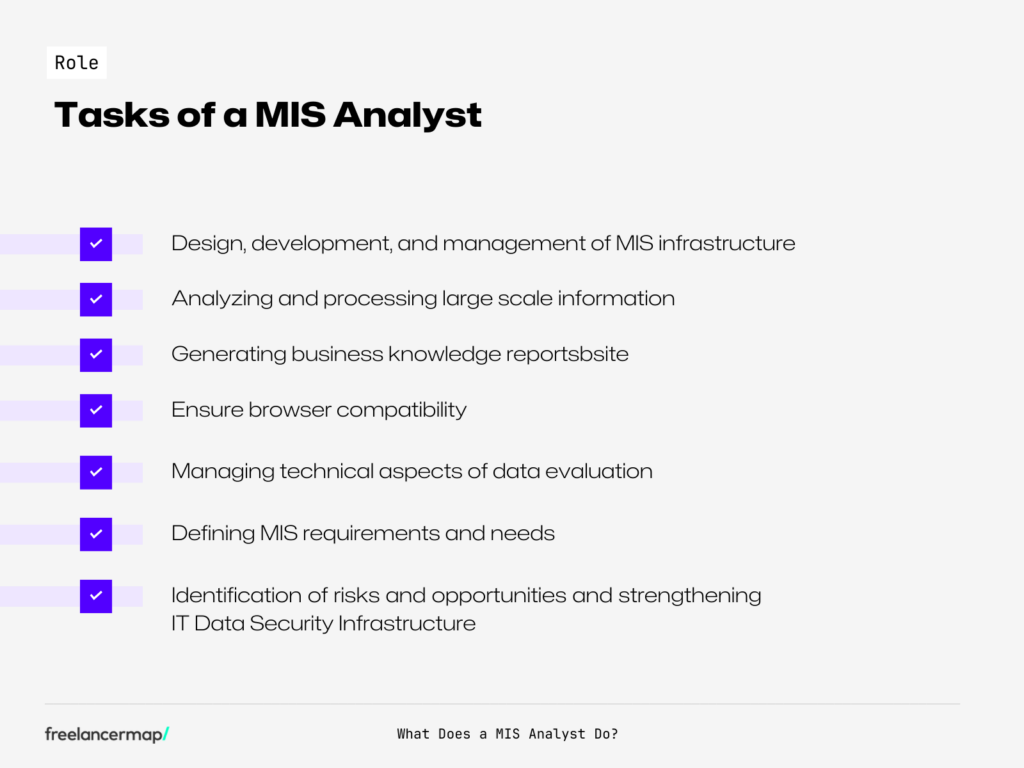
- Design, development, and management of MIS infrastructure
- Analyzing and processing large scale information
- Generating business knowledge reports
- Managing technical aspects of data evaluation
- Defining MIS requirements and needs
- Identification of risks and opportunities and strengthening IT Data Security Infrastructure
- Evaluating and Improve Information Processes as needed
- Performing routine Data Checks
Common MIS reports
| Report | Audience | Frequency | Typical tool |
|---|---|---|---|
| Sales performance report (revenue, pipeline, targets) | Sales leadership | Weekly | Power BI, CRM data |
| Cost-center and budget variance report | Finance, department heads | Monthly | Excel, SAP |
| Operations KPI dashboard (volumes, service levels, backlog) | Operations managers | Daily | Power BI, SQL |
| Headcount and attrition report | HR, executives | Monthly | Excel, HRIS data |
| Management board pack | Executive team | Monthly / quarterly | Power BI, PowerPoint |
Find your next freelance project
>> Browse the latest projects
Skills required as MIS Analyst
MIS analysts are great at problem-solving and have a talent for being technically savvy. They are able to take on large data sets with minimal problems. In general, they are skilled in information systems – they know how to organize, store, and analyze data.
They must be knowledgeable regarding business process improvement as this is crucial to their role as an MIS Analyst. Since they work closely with a company’s stakeholders, they must also have strong communication skills.
In order to convey important technical data, good technical writing skills are also important.

Skills required for an MIS Analyst:
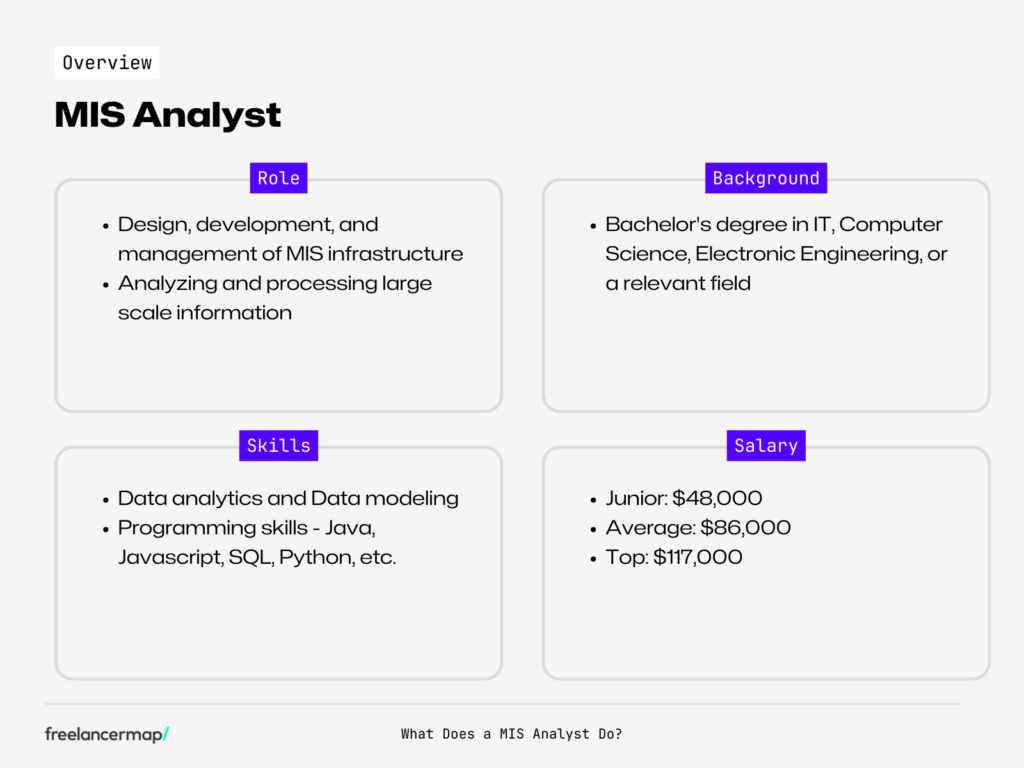
- Data analytics and Data modeling
- Programming skills (Java, Javascript, SQL, Python, etc.)
- Knowledge of information systems
- Business process improvement
- Advanced Excel and database management
- Experience with data analysis and business automation tools
- Ability to work with Alooma, Apache, and Oracle Data Integrator
- Strong interpersonal and communication skills
- Technical writing skills
Across the whole freelancermap market, SQL and Python are among the most-analysed skills, and Python sits close to a balanced ratio of freelancer profiles to projects. That makes Python a strong differentiator for MIS analysts who want to stand out in a market where many skills are oversupplied (Freelancer Study 2026).
Background & Education
MIS Analysts generally have a degree in computer science, an economics subject or business informatics. There is a wide range of data science courses available as well (e.g. MIS training – Advanced Excel + Macro + Access + SQL)
Candidates from academic backgrounds in Mathematics and Physics can also turn towards MIS as a career. Senior roles may sometimes require an MBA in Information systems as well.
There are also 3 main certifications that can enhance the resume of an MIS Analyst:
- PMP – Project Management Professional Certification
- CBAP – Certified Business Analyst Professional
- CISA – Certified Information System Auditor
MIS Analyst Salary & Freelance Rates
On average, MIS analysts earn around $66,000 gross per year. Junior level roles or new graduates can expect to earn about $42,000 per year. With considerable experience and/or in senior roles analysts may earn up to $86,000 annually.
How much does an MIS analyst earn?
| Junior | $42,000 |
| Average | $66,000 |
| Senior | $86,000 |
Freelance MIS analyst rates in 2026
As of 9 October 2026, freelance MIS Analysts on freelancermap charge an average of €60/hour. Most freelance MIS Analysts charge between €60/hour and €60/hour, depending on experience, skills, project requirements and other factors.
Based on an 8-hour working day, the average freelance MIS Analysts rate is approximately €480/day.
| Freelance MIS Analysts rates | Rate |
|---|---|
| Average hourly rate | €60/hour |
| Typical hourly rate range | €60–€60/hour |
| Average daily rate (8 hours) | €480/day |
Rates are based on current freelancermap data and may vary depending on experience, specialisation, project scope and other factors. Data last updated: 9 October 2026.
A freelance MIS analyst is the right choice when you need reporting expertise for a defined project, such as a new dashboard suite, an ERP reporting migration or report automation, rather than ongoing in-house capacity.
When freelance makes sense
- You are migrating reporting to a new system (for example SAP S/4HANA or Power BI)
- Recurring reports are manual and you want them automated once
- You need a specialist skill your team lacks, such as SAP BW or advanced data modeling
- You need to cover a gap quickly; on freelancermap, many projects are posted with “ASAP” start dates
How AI is changing MIS work
AI is automating the routine parts of MIS work, not the role itself. Tools such as Copilot in Power BI and Excel can draft queries, summarise dashboards and generate first versions of reports in minutes. That shifts value toward the tasks AI handles poorly: defining the right KPIs, ensuring data quality and governance, and explaining numbers to decision-makers.
- Shrinking: manual report building, copy-paste data preparation, basic chart creation
- Growing: data governance, KPI design, validating AI-generated outputs, automation and integration work
Other interesting profiles
- What Does An Inventory Analyst Do?
- What Does A Citizen Data Scientist Do?
- What Does A Deep Learning Engineer Do?
- What does a Data Architect do?
- What Does A Digital Forensics Analyst Do?
» More job profiles in Data Science & Analysis
Looking to hire a skilled freelancer? Create your account in just 2 minutes and start connecting with top talent worldwide!
Sign up for free
